
“There are two ways to use money. One is as a tool to live a better life. The other is as a yardstick of status to measure yourself against others.” – Morgan Housel
Hi all,
It’s been a little bit since my last update, and the valuation of the S&P 500 remains stretched. It is currently in the 93rd percentile of valuation in history, which is only to say there is a lot of optimism built into the market.
In the last quarter, something amazing occurred. Per the chart below, the amount of AI-related spending as a percentage of the overall economy became larger than all the other consumer spending in the economy. You’ve heard me say it many times to never bet against the American consumer. But in this case, everyone’s betting on artificial intelligence making companies more productive.

At some point valuation matters, and if you’re looking at the numbers in a vacuum, we’re very close to the same valuation metrics we last saw at the height of the tech bubble in 2000.

We continue to believe that the market needs a decent pullback (3-10%) to reset some valuations, and we believe that pullback will occur in the next 60 days. Historical data shows that when the S&P is positive for May, June, and July, the period between August and mid-October is bumpy (to use a nice term). The good news is that the period post-October through mid-January is positive 17 out of 17 times, for an average gain of 7%.
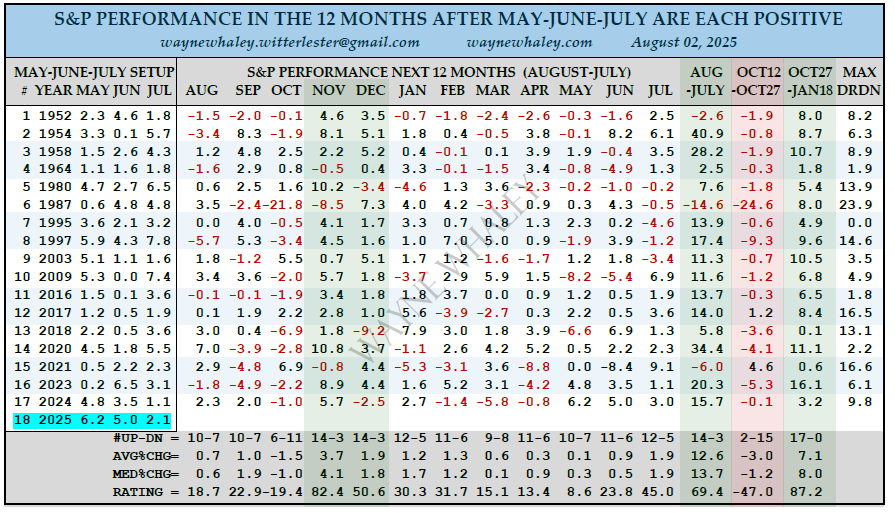
The S&P 500 is up 30% over the last 16 weeks (almost 2% per week). The only thing we know for sure is that it’s not sustainable. We’re still looking for that pullback to put additional money to work and we will stay patient to try and not chase this market where seemingly everything is working.
– Adam
There’s only two things in life about which I feel modestly comfortable about asserting my views, two things I know fairly well: the neurological capabilities of “vegetative state” (Unresponsive Wakefulness) patients and Taiwanese law/regulations. But my first academic boss was Herb Simon; I was his research assistant. Notoriously, in 1965, he predicted: “Machines will be capable, within twenty years, of doing any work that a man can do.” Wasn’t true in 1985 and it ain’t true in 2025. (For the record, Herb was one of the “fathers” of AI.) So be forewarned. And for those who worry that AI will conquer Homo Sapiens (us), will somehow control us, just look at all the people who can’t put down their cell phones, swiping mindlessly. AI will surpass us, in large part because humans and in steep cognitive decline, and I’m not referring to dementia or Alzheimer’s Disease. In aggregate, people are getting more stupid. (The Flynn Effect is methodological artifact.) LLM’s are important, but extrapolating their progress to other domains is risky. Bear in mind that LLM’s are highly dependent on the internet, which is filled with rubbish, and the availability of large numbers of underemployed people who have one talent–all have a mother tongue. These people, sadly enough, do much of the data labeling essential to increasing accuracy. In fields where people are well enough paid, e.g. radiologists, there is not sufficient incentive for for them to spend time labeling brain scans. Greed’s the problem. People like me, who believe in open science, will share all my results–carefully analyzed PET and fMRI scans of “vegetative” patients”–with the world. But databases like this are of small scale, about 100 in my case. Most people aren’t like Jonas Salk, who didn’t secure a patent on the polio vaccine, Intellect+decency combined in one person, rare. Compare Salk to Musk, and you’ll get a sense of what I mean.